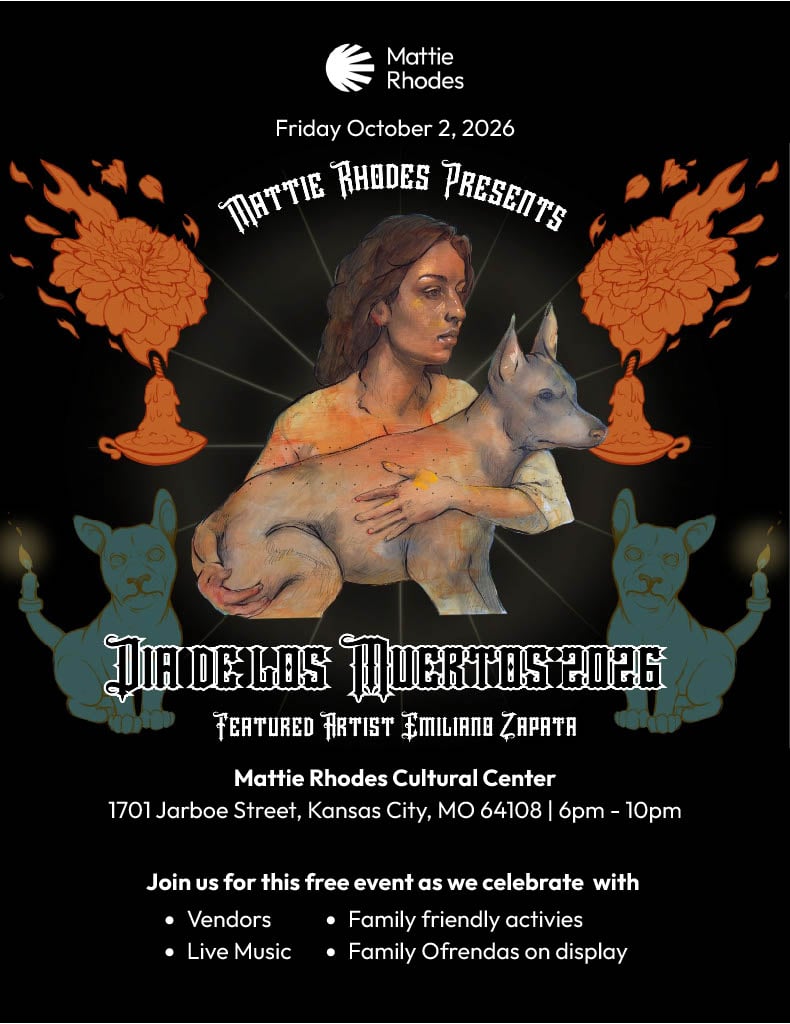
Dia de los Muertos 2026 | Day of the Dead 2026 Join us for our…
Cultural Center Papel Picado
PAPEL PICADO PANELS
(Panels 1-10 read from left to right facing the building. Panels 10-20 are closest to the building and read from right to left.)
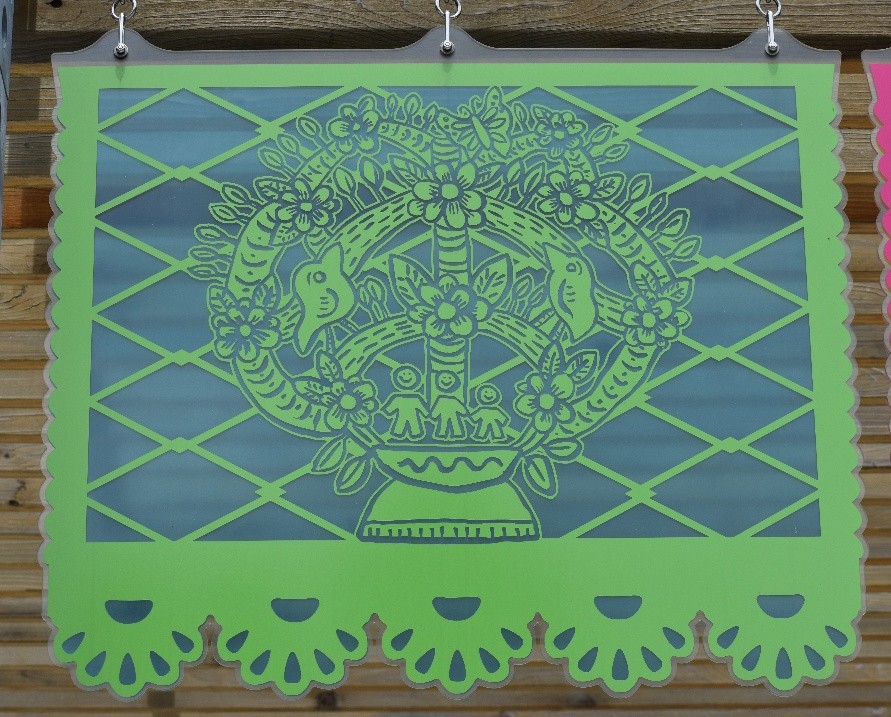
Panel 1: Tree of Life
The Tree of Life, or Árbol de la Vida, is a common motif depicting spiritual beliefs around the world. In Mexican folk art, it takes the form of intricately detailed trees that sometimes represent biblical creation scenes.
The cultural roots of the Tree of Life, however, come from the ancient Mayans. They believed that a particular tree, from the family of the silk floss tree or yaxché, was the central axis of the universe. According to the Popol Vuh, a sacred text that recounts the mythology and history of the Mayans, the gods planted four silk floss trees to mark the four cardinal points. It was also believed that the branches were connected to the heavens, the trunk was connected to the earth, and the roots were connected to the underworld.
The creation of Trees of Life is part of the pottery and ceramic traditions of central highlands of Mexico. Pottery in this area can be traced back to between 1800 and 1300 B.C.E. – including clay figures. After the arrival of the Olmec to the area, the clay figures began to be painted and around 800 C.E., Teotihuacan and their influence brought religious symbolism to many ceramic wares. After the Spanish colonizers arrival in 1519, religious leaders from the Catholic Church begin to destroy articles, including ceramics- which depicted their religious figures and gods, and replaced them with images of saints and other Christian iconography.
The first Tree of Life is believed to have been made by Timoteo González in 1945 as a small commission. In the following years, the creation of the Trees evolved in their size, materials, technique, and religious iconography. Trees of life are produced primarily in three regions: Izúcar de Matamoros and Acatlán in Puebla, and Metepec in the State of Mexico. Traditionally, they were used as a gift for newlyweds as a symbol of fertility and abundance. They have evolved over the years and now can be seen with images representing Mexican culture and history including decorating Day of the Dead altars to remember past loved ones.
Mattie Rhodes’ Hand in Hand Collection (some of which you can see on the wooden display cases inside the Cultural Center) has over 20 trees of life in a variety of colors, shapes, and sizes. Many of these pieces were created by artisans in Oaxaca, Mexico and incorporate many of the elements described above— such as birds, fruit, people, moons, and suns.
For more information:
https://www.byarcadia.org/post/mexican-folk-art-101-the-tree-of-life
https://mattierhodes.org/cultural-arts/collections/
Panel 2: Quetzal
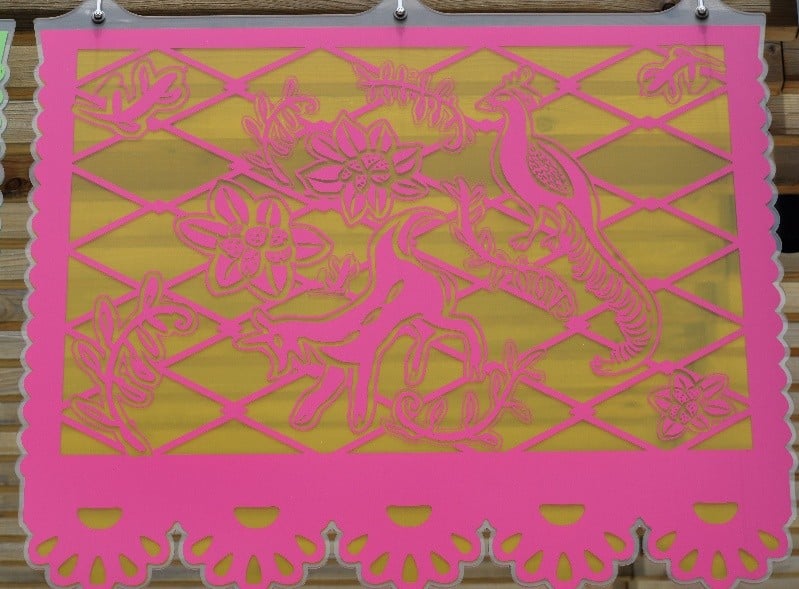
Once a symbol of divinity in pre-Columbian Mexico, these resplendent birds are found in the cloud forests of Central America, ranging from southern Mexico to Panama. Specifically, they can be found in mountainous regions of Guatemala, Costa Rica, Panama, and parts of Mexico. Quetzals are known for their vibrant green plumage and long, iridescent tail feathers, and they are the national bird of Guatemala. The word Quetzal comes from the Nahuatl word quetzalli which means “beautiful shining feather”. The name is associated with its iridescent plumage, which is such a rare color that it varies according to the light of the day and makes a visual contract with the red of its belly and its immense tail, so large that it can reach up to 90 centimeters.
For the cultures of Central and Southern Mexico, the quetzal was a sacred creature. The Mayas associated it with Kukulkan, and the Mexica associated it with Quetzalcoatl. Quetzalcoatl was a benevolent deity linked to creation, fertility, and wisdom. The quetzal was seen as a manifestation of Quetzalcoatl and was a symbol of life’s continuous renewal and the interconnectedness of living beings.
For more information:
https://datazone.birdlife.org/articles/the-resplendent-quetzal-in-aztec-and-mayan-culture
Panel 3: Milagros
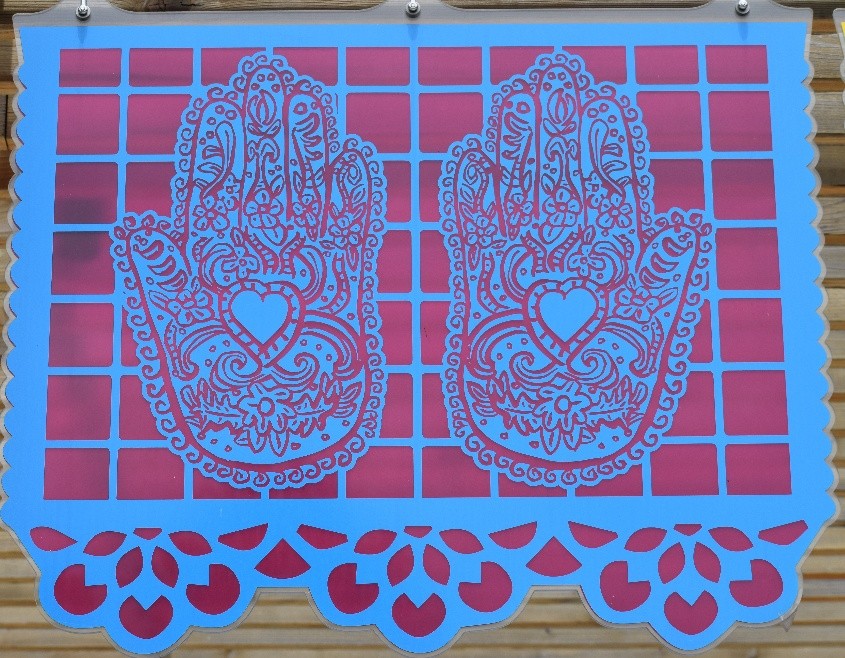
Milagros derive from North, Central, and South America. In Mexico, the use of milagros relates to an institution known as the manda. The manda is a request for a favor from a saint in which the person must repay them after the favor has been granted. The person must make a pilgrimage to the shrine of that saint, take a milagro, and leave it there. Milagros are also used by curanderas or spiritual healers as they may bless a milagro and recommend that a person carry it in their pocketbook or on their person, in order to cure a physical ailment or to ward off evil or bring about a change of fortune.
Milagros come in a variety of shapes and sizes- ranging in size from less than 1/2 inch to several inches. Some examples of commonly seen milagros are hearts, arms, hands, and a variety of animals like dogs and chickens. They are as unique as the cultures that produce them.
Hand-shaped milagros represent friendship, love, and charity. They are believed to strengthen and grow relationships- both platonic and romantic. They remind us of our connection to one another.
For more information:
https://lammuseum.wfu.edu/2024/10/mexican-milagros/
Panel 4: Calavera
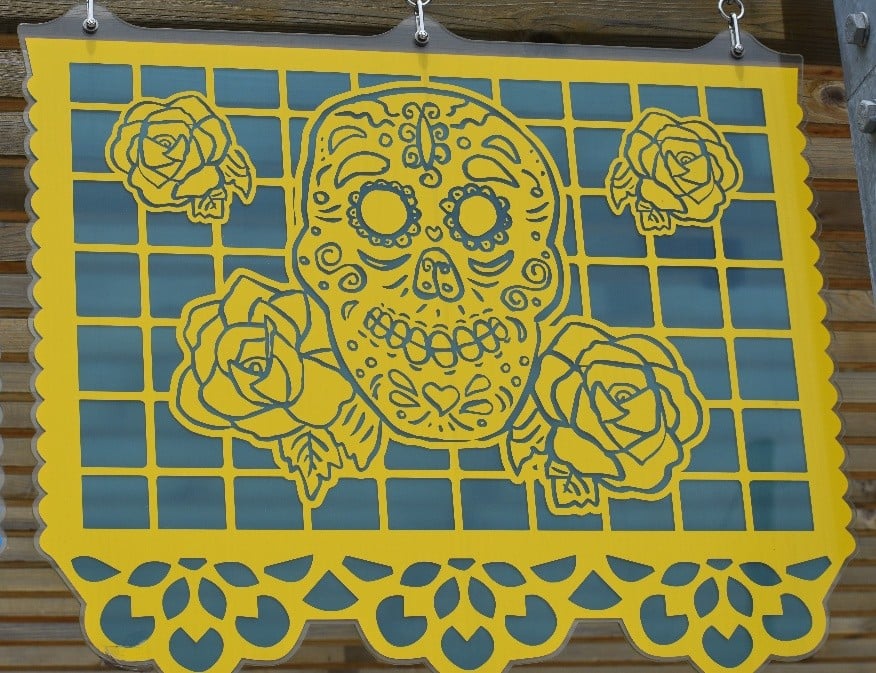
The Calavera is a representation of a human skull. The term is most often applied to edible or decorative skulls made (typically by hand) from either sugar (called alfeñiques) or clay, and are used in the Mexican celebration of the Day of the Dead (Día de Muertos) and the Roman Catholic holiday All Souls’ Day. A calavera can also refer to any artistic depiction of skulls, as represented by the La Calavera Catrina or La Catrina lithographs of Illustrator José Guadalupe Posada. He created these illustrations as part of his series of satirical lithographs that addressed political and social issues during the years of the Mexican Revolution.
The figure subsequently become the face of the Dia de Muertos holiday and was inspired by the Mexica’s queen of the underworld, Mictēcacihuātl. She was the central figure for the deceased in Mexica culture, as they celebrated death as a part of the cycle of life, leaving offerings or temporary altars or “ofrendas” intended to assist them on their journey. The ofrenda tradition has carried on to present day – combining with Catholic customs revolving around All Saints Day. The most widely known calaveras are created with cane sugar and are decorated with items such as colored foil, icing, beads, and feathers.
For more information:
https://www.pbs.org/newshour/arts/how-la-catrina-became-the-iconic-symbol-for-the-day-of-the-dead
Panel 5: Mattie Rhodes Sun Icon
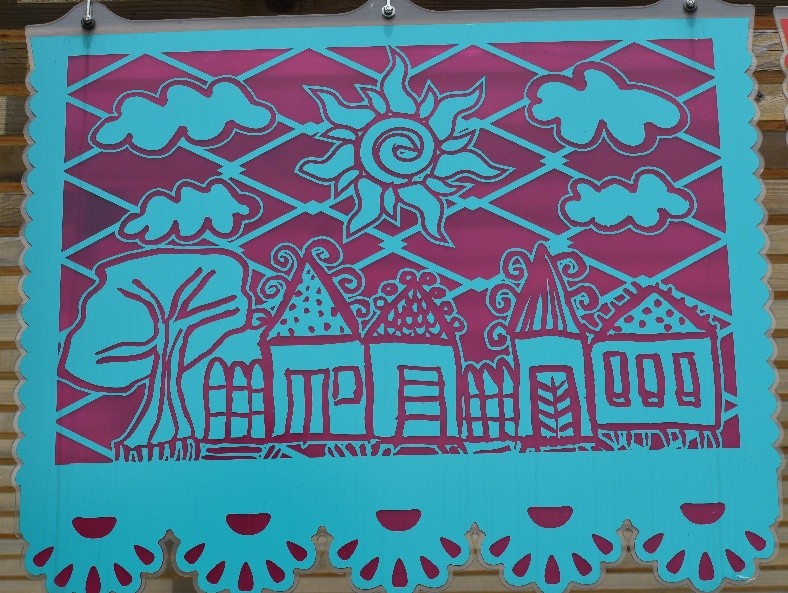
The sun and moon held a deep significance in Mayan and Mexica (also referred to as Aztec) societies, as they incorporated them into their religious beliefs, rituals, and calendar systems. The symbol of the sun is also ever-present in folk art and often seen in festivals, rituals, and as symbols of life cycles, connecting traditions of the past with contemporary practices. Indigenous beliefs about cosmic balance and the duality of the sun and moon reinforce the spiritual significance in Mexican folk art today.
Similarly, the sun holds a deep significance with the so many people in Kansas City, as the image has been associated with Mattie Rhodes and the organization’s impact on the community since the early 1990s. While the sun icon originated in the early 1990s, Mattie Rhodes has been serving the Greater Kansas City area for over 131 years. The organization was started with a $500 donation from nineteen-year-old Mattie Florence Rhodes as she lay dying of typhoid fever in 1890. Mattie was a teenager who worked with the less fortunate alongside a group of her friends with their church called the Little Gleaners. The Little Gleaners honored Mattie’s dying wish in 1894 by founding the Mattie Rhodes Memorial Society. This was their pledge: “I promise to do all I can to help the needy and suffering by working for them, learning about them, giving for them, and trying to interest others in them.”
In the early years, the agency provided day care for children of working mothers and basic necessities for families who needed a little extra help. During the Great Depression, Mattie Rhodes Memorial Society provided shelter and basic needs to those facing hardship by operating a settlement house for children, single mothers, homeless individuals, and the elderly. Based on a community needs assessment in the 1950s, Mattie Rhodes began offering behavioral health and social services programs. Beginning in the late 1980s, in response to a growing need for behavioral health and social services for Spanish-speakers, the organization began hiring bilingual therapists and case managers. The Mattie Rhodes Art Center was also established in the late 1980s, followed by the Mattie Rhodes Art Gallery in 1999.
Today, Mattie Rhodes is proud to continue her legacy in our 131st year of meeting community needs through our specialized services for Kansas City’s most vulnerable populations. We fulfill our mission by providing culturally competent programming that addresses the social determinants of health: community behavioral health and violence intervention and prevention, youth development, community economic development, public health, and emergency assistance.
For more information:
https://mattierhodes.org/about-mattie-rhodes-2/mattie-rhodes-history/
Panel 6: The Sacred Heart/Corazon Sagrado and Significance of Corn
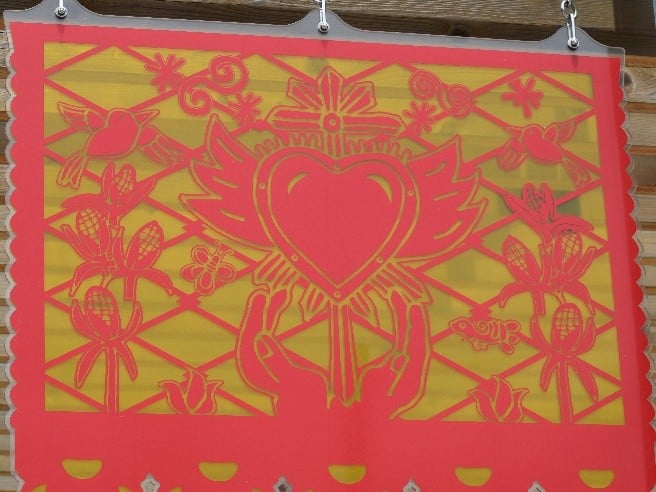
The Corazón Sagrado or Sacred Heart is one of the most common motifs in Mexican folk art and holds both cultural and religious significance in Mexican culture. Like much of Mexico’s complex and layered history of colonization and the influence of Indigenous, African, European, and Asian cultures that helped to shape the nation, the sacred heart lies at the intersection of both Indigenous and Spanish cultures. The image of a bleeding heart appeared in pre-Columbian Mexico and was part of Mixtec sacrifice and its association with fertility. The Mexica also viewed the heart as a person’s life force and source of intelligence, as they believed the heart contained a person’s soul or teyollia.
Just as the sacred heart held deep symbolic and religious significance to the Indigenous peoples of Mesoamerica, the Spanish conquistadors believed that the sacred heart represented love and hope for humanity. The Catholic Sacred Heart is often depicted with flames, rays of light, thorns, a dagger, and a cross, each holding specific religious meaning. Flames can represent God’s “passionate love and eternal hope”, thorns symbolize sacrifice and pain, and rays of light can refer to Jesus as the “light of the world”. Following colonization and an immense conversion to Catholicism, the Corazón Sagrado became woven into Mexican culture and spirituality, as it became a connection between their pre-Columbian beliefs and the indoctrination of the Catholic faith.
Significance of Corn in Ancient Mesoamerica:
Scientists think that maize began the process of domestication as long as 9000 years ago, when people in Mesoamerica began cultivating its ancestor, Balsas teosinte. The oldest maize pollen, about 8700 years old, comes from the Balsas Valley of Mexico, which is thought to have been the cradle of maize domestication. However, analysis of human remains from Mesoamerica indicates that maize only became a significant part of some peoples’ diets between about 4700 and 4000 years ago, shifting to a dietary staple after 4,000 years ago.
The Olmec civilization (1200 to 400 BCE), which was located in the region of modern-day Tabasco and Veracruz, southeastern Mexico, initially flourished without relying heavily on maize as a dietary staple. About 3,000 years ago (900 BCE), maize began to become a much more important part of the Olmec diet and culture.
The Mayan Civilization, which had its peak from around 250 CE to 950 CE, was centered in the same region as the Olmec civilization. Maize was so important to the ancient Mayans that it had spiritual and religious significance. According to Mayan legends, humans were created from maize. Many other Mayan legends revolve around maize, and images of maize have been found on Mayan artifacts, murals, and hieroglyphs.
For more information:
https://niemanreports.org/using-a-cultural-icon-to-explore-a-peoples-heart/
https://flaar-mesoamerica.org/2020/08/10/maize-the-most-important-crop-for-the-mayan-culture/
Panel 7: Ballet Folklórico
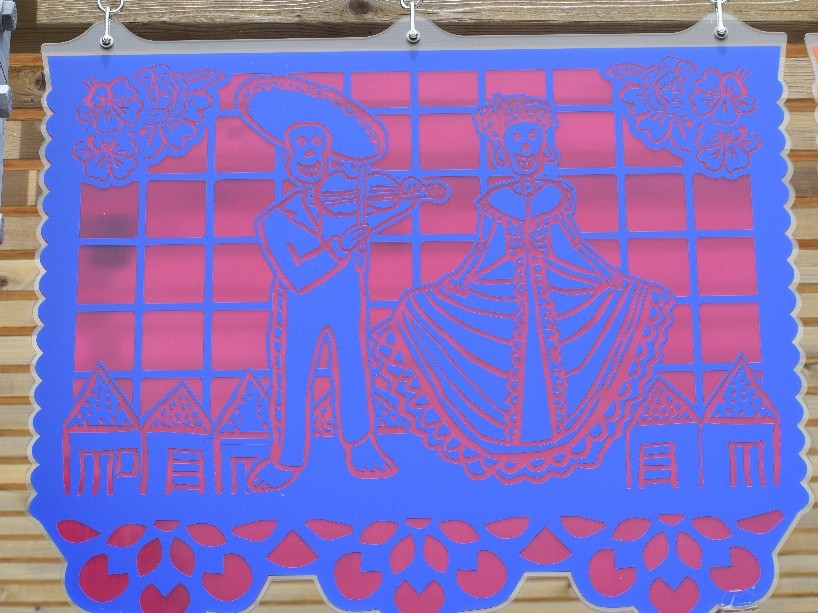
Ballet folklorico is a term that encompasses a wide range of regional dances from Mexico, each with its own distinctive costumes, music, and choreography. The origins of ballet folklórico can be traced back to the pre-Columbian era when Indigenous peoples performed ritual dances to honor their gods and ancestors. With the arrival of the Spanish colonizers, the dances were influenced by European styles such as flamenco, polka, and waltz, as well as African rhythms brought by enslaved people. The dances also reflected the historical and social changes that occurred in Mexico, such as the independence movement, the revolution, and mestizaje (a complex term that describes the mixture of Indigenous and European ancestry and cultures— learn more about mestizaje from the Mexico Solidarity Project linked below)
For more information:
https://mexicosolidarityproject.org/voices/61/
Ballet Folklorico: A Dance of Identity
https://www.youtube.com/watch?v=B2EgBcGahJo
Panel 8: La Adelita
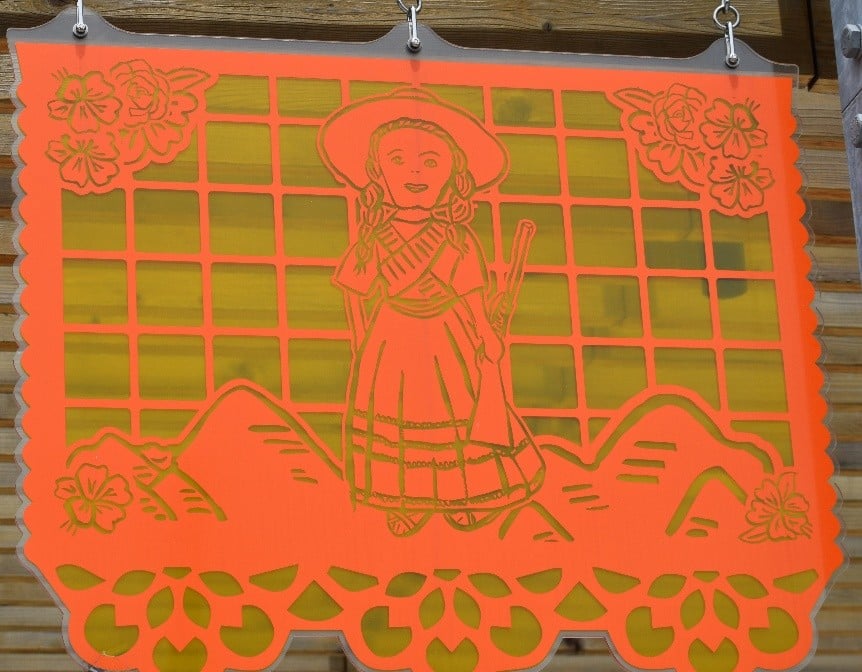
Adelitas, also referred to as soldaderas or female soldiers, were women who played vital role in the Mexican Revolution (1910-1920). The origins of the Adelitas are rooted in the political and social conditions of Mexico in the early 20th century. Adelitas helped the war efforts in a variety of ways, as they were nurses, cooks, spies, and even soldiers on the front line—as women were not allowed to fight on the fields.
The term is believed to have derived from a popular corrido (or song) that romanticized a female soldier who embodied the ideals of the Mexican Revolution- such as bravery, loyalty, and patriotism. The corrido was very popular among the troops and is believed to have been inspired by the soldadera Adela Velarde Perez. While the Adelita corrido celebrated these women, it also romanticized their roles and sometimes downplayed their combat roles and emphasized their beauty and loyalty. Since many corridos were often sung from the perspective of men, the focus of the songs have tended to focus on aspects that align with their own understanding of women’s roles at the time.
Today, the Adelita figure has largely been reinterpreted and reclaimed by contemporary feminists as a symbol of female agency, resistance, and empowerment. The image serves as a reminder of women’s struggles and the ongoing fight for gender equality.
For more information:
From Soldadera to Adelita: The Depiction of Women in the Mexican Revolution
Mexico’s Nobodies: The Cultural Legacy of the Soldadera and Afro-Mexican Women by B. Christine Arce
https://sunypress.edu/Books/M/Mexico-s-Nobodies2
Panel 9: Xoloitzcuintli and Cat Alebrijes
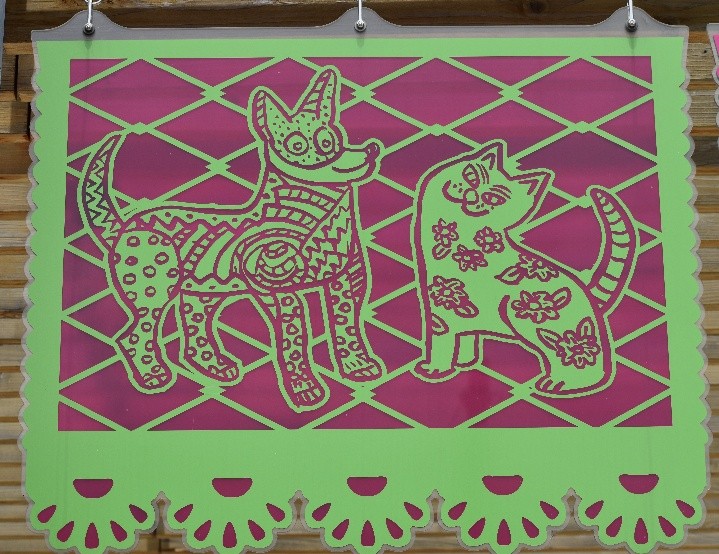
The Xoloitzcuintli one of the oldest dog breeds in the Americas, and its presence in Mexican culture is a direct link to its pre-Columbian past. This hairless dog hails from Mesoamerica and archeological evidence shows these dogs, affectionately known as ‘Xolos’ for short, are depicted on pottery from western Mexico. Xoloitzcuintli remains located at burial sites are believed to be a guarantee the owner’s dog would accompany them into the afterlife. Their remains were also found at Templo Mayor (or the main temple) in Mexico City, the symbolic center of the Aztec Empire known as Tenochtitlán.
Xolo dogs were connected to Mesoamerican daily life and cosmologies. On the earthly plane, they protected people and their homes. They also helped hunt turkey and deer. Since their body temperature runs high, they were used as hot-water bottles to treat various illnesses. They were also consumed on special occasions. In addition to their earth-bound functions, they were considered sacred and to have mystical powers able to ward off evil spirits.
Dia de los Muertos celebrations held on November 1st and 2nd, honor the deceased and would not be complete without the beloved xolo. Often present at the celebration, this small dog has a big role in the afterlife. According to Mexica folklore, most humans would have to travel through eight levels of the underworld before arriving at the final level, where they would find their final resting place. This perilous 4-year journey was full of challenges, including the crossing of the unswimmable Apanohuacalhuia River. Each xolo would wait at the river’s shore for their master’s call to help ferry them on their back across the treacherous waters. There are many variations of this story, but they all include the help of a dog.
While there is little evidence that cats in Mesoamerica were domesticated in the same way that dogs were, they may have benefitted from human settlements by preying on rodents. However, they were not bred for specific traits or kept as domesticated pets. The ancient Maya routinely captured and traded wild jaguars and pumas for symbolic and ritual purposes, according to an analysis of animal remains from the Mayan city of Copan, in present-day Honduras. Jaguars were probably the most feared and revered animals in Mesoamerica. The Ancient Maya believed that at night, the sun, as it slips into the underworld, would transform into a jaguar. A powerful predator, the animal was also associated with warriors and hunters, and became a symbol of power and authority.
For more information:
https://www.americanindianmagazine.org/story/Xoloitzcuintli-the-Hairless-Dog
https://www.sci.news/archaeology/ancient-maya-captured-traded-big-cats-06415.html
Panel 10: Eagle/Serpent
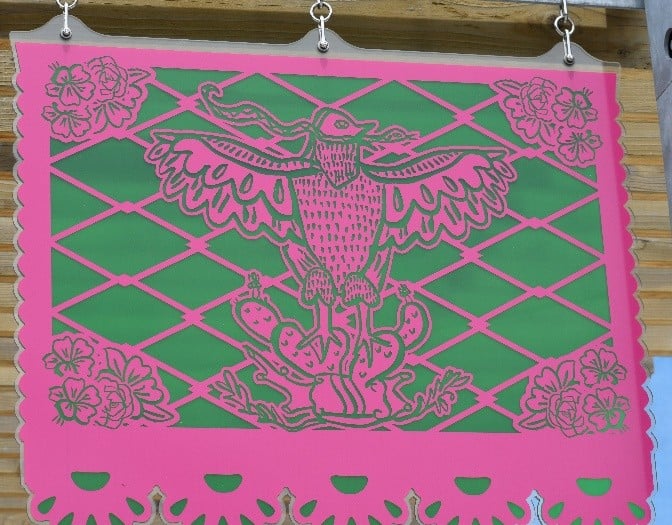
The story of Aztlán, a mythical place steeped in mystery and rich in cultural significance for many Mexicans and their descendants, is believed to be the original home of the Mexica people. The word Aztlán translates to “Place of the Herons” or “White Land”. This mythical place was described as a paradise surrounded by glistening waters and lush landscapes. According to folklore, Azlán was a utopia where the Mexica thrived under the watchful eyes of their gods. It was the cradle of the Mexica civilization, where they lived in harmony with nature and the deities they worshipped. However, this peaceful existence did not last, and legend tells that the god of the sun, war, and sacrifice, Huitzilopochtli (meaning Hummingbird of the South) appeared and instructed the leaders of Aztlán to tell their people to leave their homeland and find a new place where they could establish a great city. Huitzilopochtli warned the Mexica leaders that the journey would be challenging but promised them a sign that would let them know where to establish their new homeland— a vision of an eagle perched on a cactus, devouring a serpent.
Obeying their god’s instruction, the Mexica’s packed their belongings and embarked on their journey. Legend says that they wandered for years, as they crossed deserts and mountains and endured many hardships. But they never lost faith in Huitzilopochtli’s prophecy. Finally, they arrived in the Valley of Mexico, a vast and fertile basin surrounded by mountains and bisected by lakes. It was here on this small island, known by the name of Mexico, in the middle of Lake Texcoco, the weary Mexica witnessed the foretold sign— a majestic eagle, perched atop a prickly pear cactus, with a serpent clutched in its talons. It was here where they built their new empire and established Tenochtitlán (translated to the “Place of the Prickly Pear Cactus” in Nahua), one of the most powerful empires in pre-Columbian America.
Cultural Relevance of the Eagle and the Serpent Today
The mythical Aztlán remains a foundation for Mexican identity today and continues to influence cultural identity and heritage. The story of Aztlán and the founding of Tenochtitlán are deeply rooted in the symbols that represent Mexico today. The image of the eagle perched on the cactus is central to Mexican identity and history. The cultural symbolism of Aztlán also holds significance to many Chicanx/e (a gender inclusive term used to refer to people of Mexican American heritage) people living outside of Mexico.
For more information:
https://smarthistory.org/serpents-mexica/
Panel 11: Alebrijes
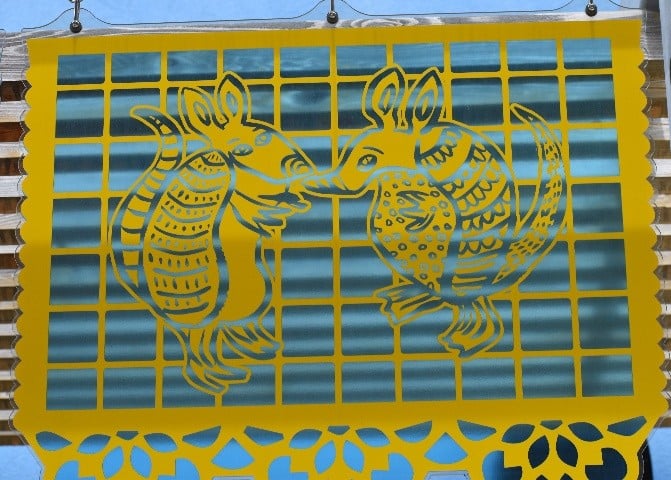
Alebrijes are brightly colored Mexican folk art sculptures of fantastical and mythical creatures. Folk artist Pedro Linares López, born in Mexico City’s La Merced neighborhood, is celebrated for creating and popularizing alebrijes. In the 1930s, while bedridden with peritonitis, he experienced a vivid fever dream in which fantastical creatures emerged from rocks, trees, and plants. These mythical beings chanted one word, “alebrije.”
Inspired by this vision, Linares made the creatures using papier-mâché and cardboard. His creations were not well-received until a gallery owner showcased his work, which caught the attention of artists Frida Kahlo and Diego Rivera. Linares’ children and grandchildren continue to make alebrijes in Mexico City. Armadillos are popular in folktales from Argentina, Oaxaca, Bolivia, and Mayan culture.
Mattie Rhodes’ Hand-in-Hand Collection (some of which is currently displayed inside the Cultural Center) consists of over 1,500 pieces of folk art from around the globe. The collection includes sculptures, ceramics, toys, miniatures, masks, and textiles. Among these pieces, are a variety of colorful and creative alebrijes from Oaxaca, Mexico City, and the American Southwest.
For more information:
https://uknowledge.uky.edu/world_mexico_alebrijes/
https://mattierhodes.org/cultural-arts/collections/
Panel 12: La Sirena
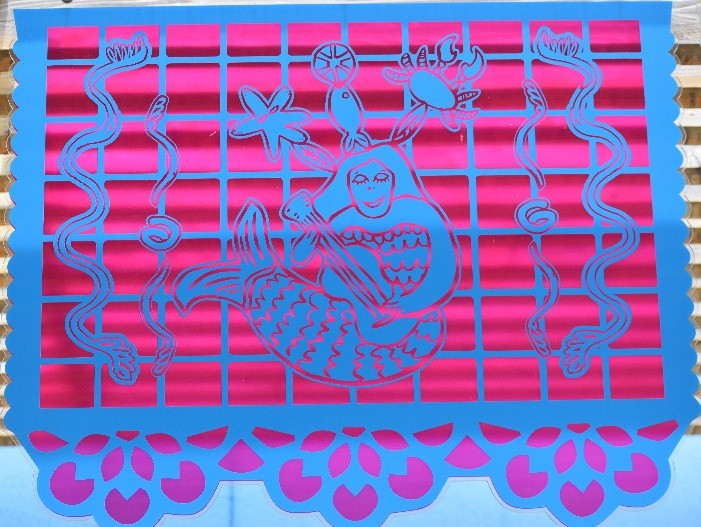
In Mexican folklore, mermaids possess a dual nature. Often represented as a mermaid, the Mexica goddess known as Chalchiutlicue is described not as half-human and half-fish, but as half-human and half-sea serpent. In the Mexica or Aztec religion, the water and fertility goddess was the wife of the rain god Tlaloc, an ancient deity had had long been worshipped throughout Mesoamerica. Chalchiutlicue symbolized the purity and value of spring, river, and lake water that was used to irrigate the fields. As a fertility goddess, she portrays the Mexica ideal of young womanhood. She is also closely related to the Mexica corn goddess Chicomecoatl, who is often also shown wearing a headdress, while holding ears of corn in her hands.
In Mexican popular culture, La Sirena is depicted in Lotería—a traditional Mexican board game of chance similar to Bingo. Like many Loteria symbols, La Sirena also carries cultural weight, representing the duality of beauty and danger, and the need to navigate life’s temptations with caution.
More information about Lotería:
https://learninglab.si.edu/collections/la-loter%C3%ADa-a-mexican-bingo-game/bDNuPbo5ATe3wfPx
Panel 13: Mariposa/Monarch
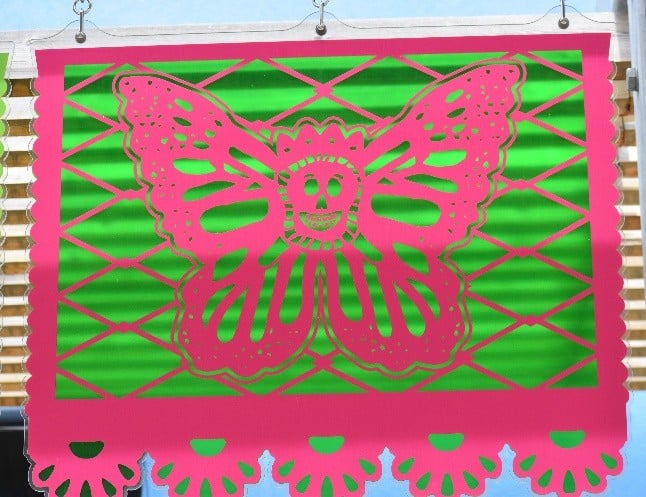
Mariposas or Monarch butterflies play a large role in Día de los Muertos celebrations. Each fall, like clockwork, millions of monarchs migrate to Mexico from Canada. The monarchs descend on the highland forests of central Mexico and their arrival marks the finish line of a 3,000-mile journey. Once in a lifetime, the butterflies fly south from their summer breeding grounds in Canada and the U.S. and return to the same oyamel fir forests as so many generations before them. Each year, millions of monarchs make their incredible journey and take shelter in Mexico for the winter months to come. It is even more extraordinary that the monarch’s internal compass navigates them, generation after generation, to the same overwintering site and is still not entirely understood.
Indigenous forest communities of central Mexico, specifically the Purépecha of Michoacán and the Mazahua of Estado de Mexico— revere the monarchs. According to pre-Columbian folklore, the migrating butterflies carried the souls of ancestors visiting from the afterlife. For centuries, Mexican monarch have served as a powerful cultural symbol of connecting the living with their deceased ancestors.
The Day of the Dead that is celebrated today in Mexico and its diaspora on November 1st and 2nd, has pre-Columbian origins that predate the arrival of the Spanish. Some Mesoamerican peoples worshipped death, but the tradition that is celebrated today is related of the cosmovision of the Mexicas (or Aztecs) and their beliefs that death revolves around two divinities. These divinities are known as Mictlantecuhtli and Mictecacíhuatl, god and goddess of Mictlān, or the world of the dead. According to folklore, Mictlān consisted of nine regions— of which, only people who died of natural causes could enter. Once the person died, they began their journey through nine levels, and they had to overcome a variety of obstacles to free their soul. The journey lasts for a total of four years and if the dead complete it successfully, they can reach their final rest.
For more than 25 years, Mattie Rhodes has been honoring this ancient tradition with our Day of the Dead festivities which includes an altar exhibition made for and by members of the community, cultural workshops and tours, and related street celebrations of the Westside. Our annual celebrations began in the classrooms of the Mattie Rhodes Art Center where children worked on Dia de los Muertos themed projects after school. It was one of those classrooms that Richard Bay, a local artist and art educator in the Kansas City Public School District, held a discussion night about the holiday to an impressive crowd gathered to learn about its traditional practices. The community’s interest was apparent, as was the need for more space, and thus a gallery was opened next door in order to foster a space for cultural and artistic education. Mattie Rhodes is proud to be an integral part of the community in Kansas City and beyond, and to be able to offer a space to remember our loved ones and celebrate our shared culture for many years to come.
For more information:
https://folklife.si.edu/magazine/monarch-butterflies-mexico-culture-conservation
https://cwis.org/2020/10/nine-steps-to-death-unburying-the-origins-of-a-tradition/
https://mattierhodes.org/dia-de-los-muertos-day-of-the-dead/
Panel 14: Our Lady of Guadalupe/La Virgen de Guadalupe
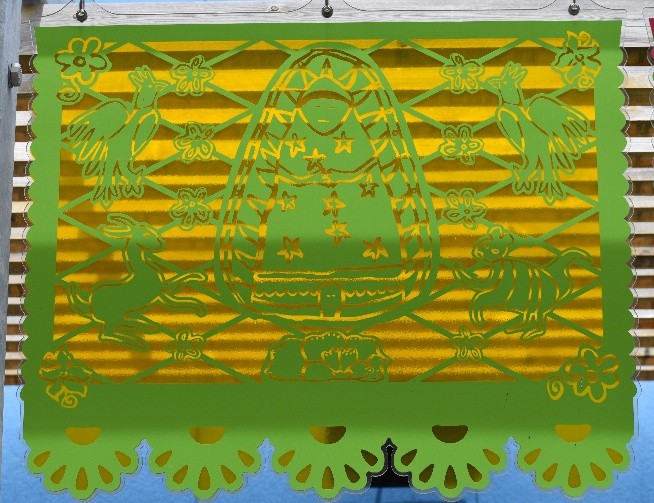
Our Lady of Guadalupe is a significant religious and cultural figure on both sides of the United State/Mexican border to Mexicans and their descendants. According to Catholic tradition, she first appeared as an apparition to a Nahua man by the name of Juan Diego as he journeyed across the hill of Tepeyac in December 1531. She instructed him to have a bishop build a shrine in her honor by miraculously revealing her image on his tilma or cloak.
Historically, Tepeyac once served as an ancient pilgrimage site dedicated to several pre-Columbian earth deities. These earth deities were referred to in the early colonial period by the generic name Tonantzin, meaning “Our Revered Mother.” The apparition that appeared to Juan Diego was of an Indigenous woman with dark brown skin and dark hair, which stands in stark contrast from the predominant Eurocentric interpretation of Mary.
The iconography of the woman with clasped hands in piety, an averted gaze, adorned in a blue cloak and surrounded by a sunburst of light is prevalent throughout Mexican culture and art. The image of Our Lady of Guadalupe has been interpreted by artisans such as the Aguilar Sisters and the Blanco family (some of these ceramic pieces can be seen on display at the Cultural Center). The image of the La Virgen remains a symbol for so many of faith, struggle in the face of adversity, pride in Indigenous identity, and as a powerful cultural icon.
For more information:
https://scholarscompass.vcu.edu/cgi/viewcontent.cgi?article=1443&context=ees
Panel 15: Acapaxapo
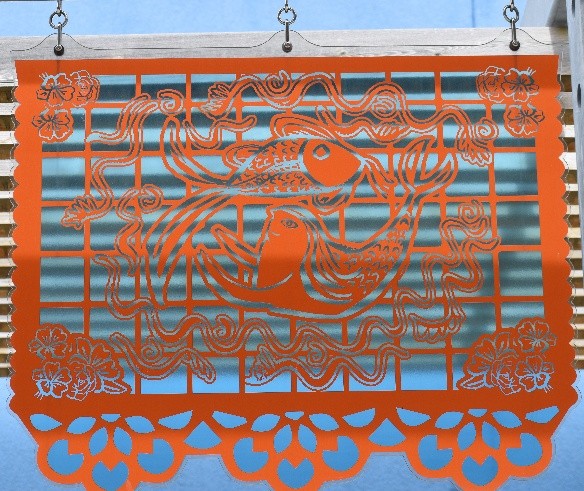
Acapaxapo (sometimes spelled Acpaxapo) is an Otomi goddess and thought to be a manifestation of the moon goddess. The Otomi people are an Indigenous group in Central Mexico, specifically near northern Guanajuato, eastern Michoacan, and southeastern Tlaxca.
Many Otomi peoples are concentrated in the states of Hidalgo and Queretaro. The figure of Acapaxapo was revered as a goddess possessing prophetic powers and the Otomi would consult her to deliver messages and receive omens. She was said to have emerged out of the lake and sometimes took on a physical body with the upper body of a woman with long hair and light eyes. She was later adapted by the Mexica as Tlanchana, a mermaid-like figure and depicted with a snake’s tail. Unlike Acapaxapo, the Tlanchana was not purely benevolent. If rejected, she would wrap around human men and drag them underwater to their death. After European colonizers arrived, the figure was often portrayed with a fish tail.
For more information:
https://mexicounexplained.com/la-tlanchana-mexican-mermaid-legends/
Panel 16: Ojo de Dios
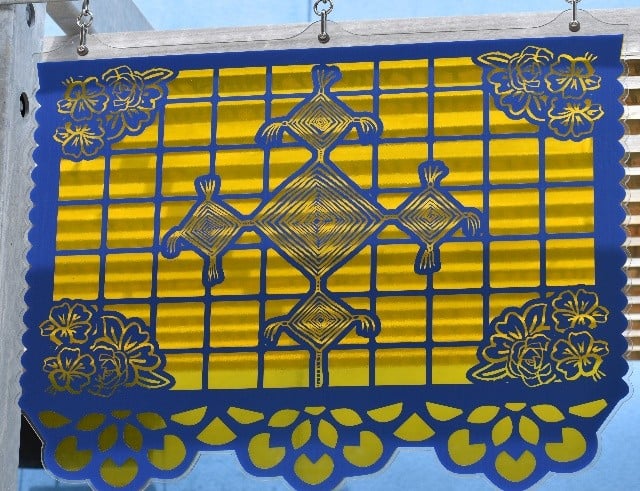
Ojo de Dios’ are rooted in the ancestral tradition of the Wixárika people (also known as Huicholes), an Indigenous community living in the Sierra Madre Mountain range in the states of Nayarit, Jalisco, Zacatecas, and Durango, with considerable communities living in the United States. Ojo de Dios (Eye of God) are believed to have spiritual power to see and understand things that the physical eye does not. The eye is used in Wixárika rituals and is believed to protect those who pray to it. The eye is a spiritual object made by weaving a design with various-colored threads onto a wooden cross.
To learn more about the Wixárika peoples and their art:
https://lammuseum.wfu.edu/2020/05/mexico-create-a-huichol-yarn-painting/
Panel 17: Duality
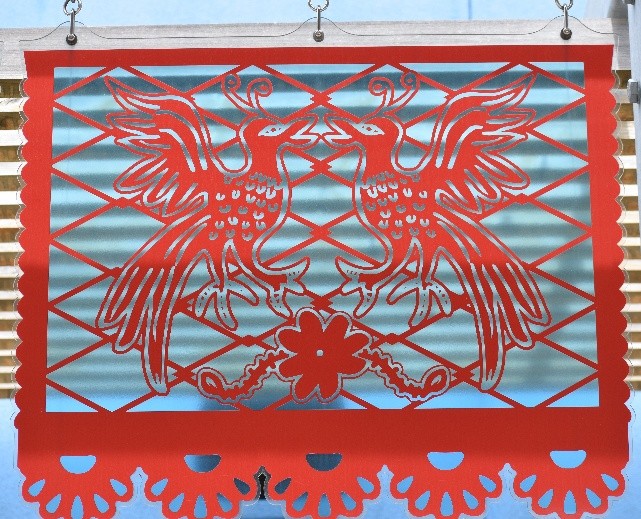
The idea of contrasting duality, in which two halves of each pair operate independently, yet are connected to each other, is integral to the Mesoamerican way of thinking. The Maya and Mexica cultures used spouses and siblings— twins in particular, to symbolize contrasting balances of duality and completion. This idea structured the worldviews of these two cultures. For the Maya, the most prominent example of mythic siblings would be the Hero Twins in the Popol Vuh.
In comparison, mythology of the Mexica empire includes the twins of Quetzalcoatl (The Feathered Serpent in their language called Nahuatl). Quetzalcoatl was often depicted with resplendent Quetzal feathers and is said to represent duality. It represents both the earth and sky, the material and the spiritual, and is associated with knowledge, creation, and wisdom. In addition to Quetzalcoatl, Tezcatlipoca (Smoking Mirror), Huitzilopochtli (Hummingbird on the Left), and Coyolxauhqui (Face Painted with Bells) were all said to represent duality in Mexica culture. These mythical creatures found in the archeological records shape the Mesoamerican belief system, which was heavily focused on contrasting dualities.
For more information:
https://scholars.unh.edu/cgi/viewcontent.cgi?article=1022&context=spectrum
Panel 18: Atotolin
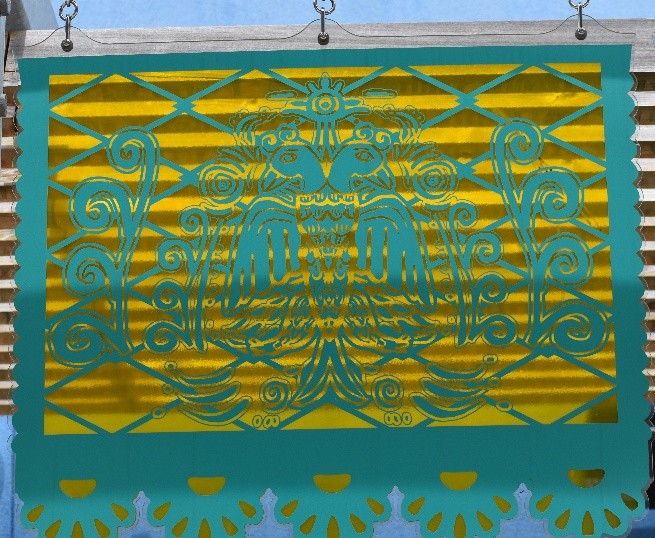
The Atotolin was known as the Mexica’s “Bird King”. Often referred to as the “water-hen or turkey, this mythical creature is associated with water and potentially with wind and death. According to Mexica folklore, the Atotolin was a large, thin water bird that has been depicted with a large yellow head. According to legend, hunters would often go on long quests to locate these creatures, but they were very difficult to find. If the hunters were unable to locate the Atotolin after four days, they would feel strong winds and hear a song floating through air. Then, the hearts of the hunters would stop, and the hunters would drown and die after their boats were sunk. Hunters that were able to find the creature had to rip open the stomach of the Atotolin to learn of their fates.
For more information:
https://www.mexicolore.co.uk/aztecs/flora-and-fauna/the-water-drum-and-other-aquatic-birds
Panel 19: La Luna/El Sol (Moon/Sun)
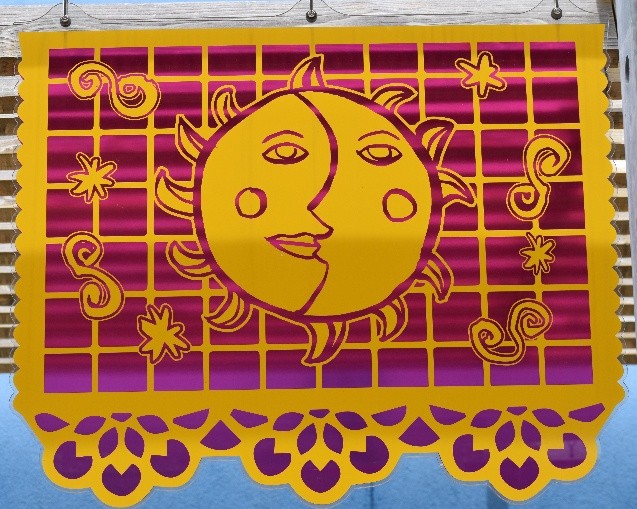
According to Mexican folklore, the moon and the sun were at one time equally bright and one of the gods feared the earth would burn under the light of two luminaries. Due to this, the god threw a rabbit in the face of the other, and the one struck darkened to become what the moon is today. After this occurred, it is possible to distinguish a figure of a rabbit on the moon’s surface. During a full moon, the “Rabbit in the Moon” becomes readily visible. The sun and moon also held a deep significance in Mayan and Mexica (also referred to as Aztec) societies, as they incorporated them into their religious beliefs, rituals, and calendar systems.
To learn more:
https://www.anthropology-news.org/articles/from-mexico-to-the-moon/
Panel 20: Xochipilli
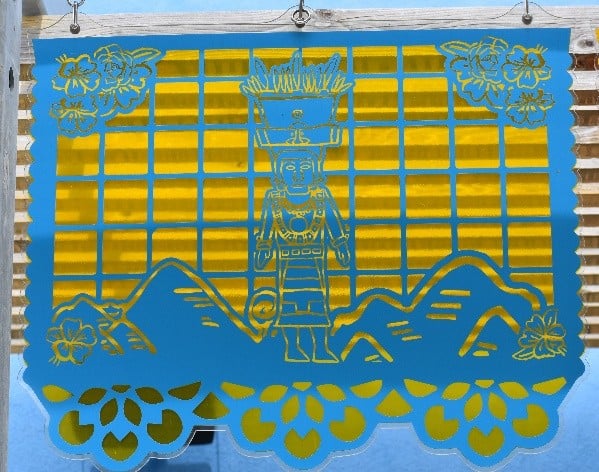
Xochipilli or the ‘Prince of Flowers’ is known as the Mesoamerican god of art, flowers, love, dancing, and creativity. He is a benevolent manifestation of Piltzintecuhtli, the young sun god who was himself is a manifestation of Tonatiuh, the supreme god of Mesoamerica. He is also closely associated with the corn god Centéotl. Xochipilli is known as a youthful and care-free pleasure-seeker, perhaps with a playfully mischievous streak. Xochipilli is also widely recognized as a queer deity, as evidence dates back to the Toltec civilization from the 10th through the 12th centuries CE. Statues of the god were also frequently decorated with flowers and even butterflies.
To learn more:
Research by:
Christina Loya
Public Historian and Community Engagement Coordinator
With special thanks to:
Luis Garcia, Maria Vasquez Boyd, and Jennifer Mendez for their time and dedication while serving on the Cultural Center Campaign committee and for the creation, research, artwork, concept, design of our beloved papel picado pieces.
Related Posts